
Link in Bio vs Website: Which One Do You Actually Need?
Should you use a link in bio page or build a proper website? The honest answer depends on what you're trying to do. Here's how to think through the decision.
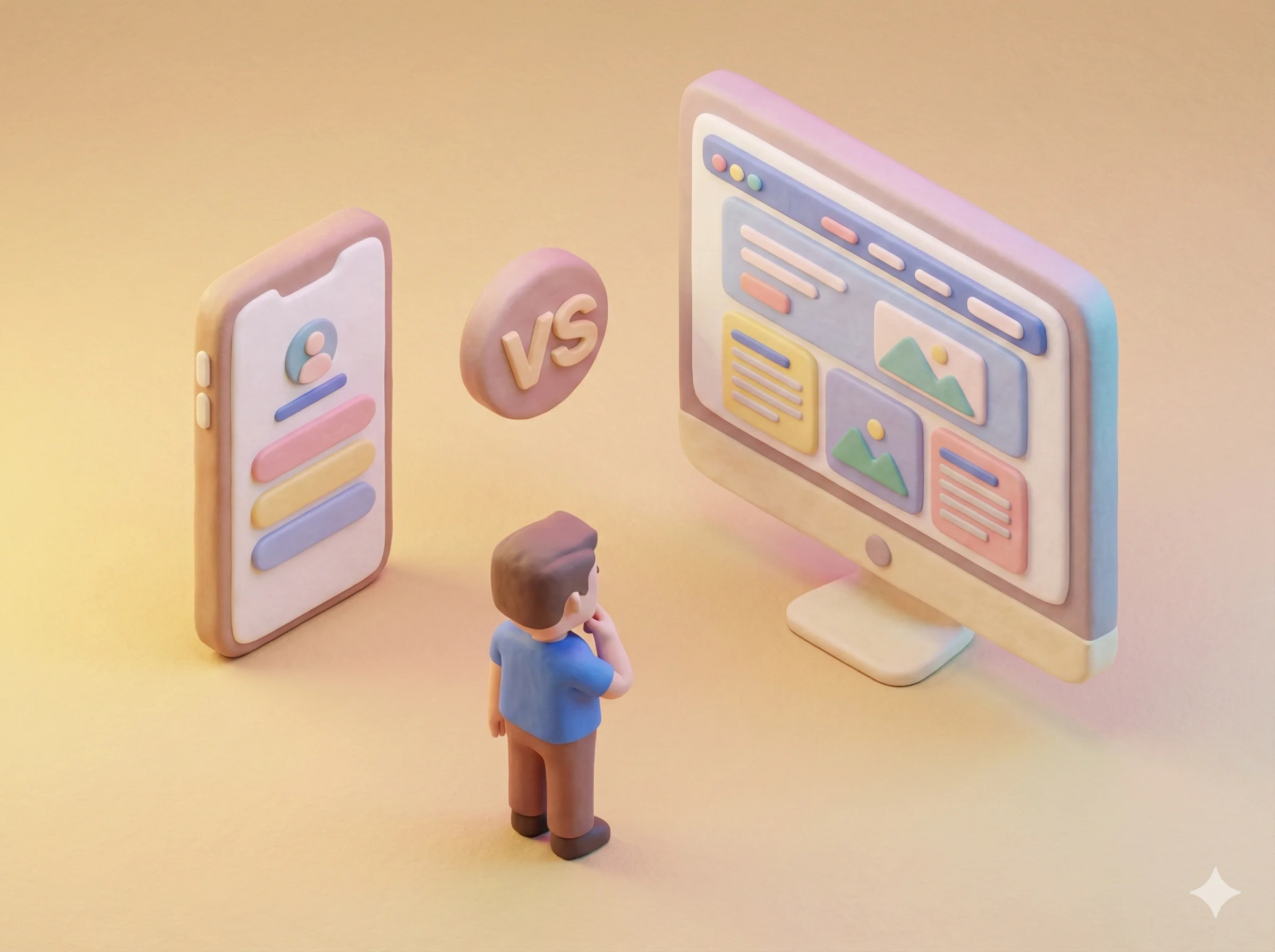
A link in bio page and a full website serve different purposes - and understanding the difference stops you from over-building something you don't need or under-investing in something you do. The short version: a bio link page is better for social traffic, and a full website is better for search traffic and complex operations.
Here is the longer version.
What Each One Is Actually For
A link in bio page is a mobile-optimized hub designed to catch people coming from social media. It holds your most important links, shows who you are, and gives visitors an obvious next step. It is built for people who tapped a link in your Instagram or TikTok bio. They are on a phone. They have a short attention span. They need to find what they came for in ten seconds.
A full website is built for a broader audience with more varied intent. Someone searching Google for "brand designer Austin" or reading a case study you published months ago is a different visitor than the one who just watched your Reel. A website can serve both audiences, but it is typically designed for the search-and-browse visitor, not the social-scroll-to-tap visitor.
These are genuinely different use cases. A homepage designed for search traffic is usually a poor landing experience for a social audience, and vice versa.
Where a Bio Link Page Wins
Setup speed. A functional, professional-looking bio link page takes under an hour to create. A proper website takes days or weeks, even with modern builders.
Mobile performance. Bio link tools are built exclusively for mobile. Websites, even responsive ones, often have elements that translate poorly to phone screens. Since virtually all social traffic arrives on mobile, this matters enormously.
Update friction. Changing your bio page takes minutes. Editing a website often requires navigating a CMS, managing plugins, or waiting on a developer. When you launch something new and need to update your bio immediately, the lower friction of a bio link tool is a real advantage.
Cost. A good bio link page costs nothing to start. A quality website with hosting, a domain, and professional design requires significantly more investment.
Clarity. A bio link page forces focus. You cannot put everything on it. This constraint tends to produce better outcomes for social traffic than a full website with twelve navigation options.
Where a Full Website Wins
SEO. A website with a proper domain, content strategy, and technical foundation compounds in search visibility over time in a way that a bio link page alone cannot — though the SEO picture is more nuanced than most people think. If organic search is a meaningful part of how you find clients or sell products, you need a website.
Complex functionality. E-commerce with inventory management, membership areas, course delivery, booking systems with payment processing - these require a proper website. Bio link tools handle simple payment links or embeds at best.
Deep content. Long-form writing, documentation, multiple layers of navigation, a full portfolio with case study pages - websites handle this better because they're designed for depth.
Credibility signals in certain markets. In B2B contexts especially, a full website with a custom domain still signals a level of establishment that a bio link page alone does not.
The Creator Who Doesn't Need a Full Website (Yet)
There is a large and underserved group of people who are told they need a proper website when they don't - at least not yet.
If you are a freelancer, creator, or early-stage professional with:
- An Instagram or TikTok following you're building
- A portfolio of work to show
- One or two services or offers
- A growing email list
...you do not need a full custom website. You need a bio page that shows your work, explains what you do, collects email addresses, and makes it easy for the right person to reach you.
Tini.bio was built for exactly this situation. Beyond links, you can publish blog posts and project pages directly on your bio page, collect email subscribers, add social networks, and customize your theme. The result is something closer to a lightweight personal site than a traditional link list. For many creators, it is genuinely sufficient as a primary web presence - not a placeholder until the real website gets built, but the real website.
When You Actually Need Both
Eventually, many creators end up with both. A full website for SEO and depth, and a bio link page that serves as the optimized front door for social traffic.
When that time comes, the smart move is to host your bio link page on a subdomain of your own domain (like links.yourname.com) rather than a third-party URL. That way your social traffic contributes to your domain's authority rather than building someone else's.
The Practical Answer
If you have no web presence yet: start with a bio link page. You can have something real and functional today. A website can come later when you understand your audience better and have more to say.
If you have a website but no bio link page: add one. Point your social traffic to a mobile-optimized page instead of a homepage designed for a different visitor.
If you're choosing between investing in a better website or a better bio link page: ask where most of your traffic currently comes from. Invest in the experience that more people actually see.
The goal is not to build the most impressive thing. It is to make it easy for the right people to understand what you do and take the next step with you.
Frequently Asked Questions
Can a link in bio page replace a website?
For many creators and freelancers, yes - especially early on. A well-built bio link page can include your bio, portfolio, blog posts, contact method, and links to your work. Where it falls short is deep SEO content, full e-commerce, and complex navigation. If you need those, a full website makes sense.
Is it better to link to your website or a link in bio page?
It depends on your website. If your homepage is optimized for a social media audience arriving on mobile, link directly to it. If your homepage is built for a different kind of visitor, a purpose-built bio link page will convert social traffic better. The landing experience matters more than the URL.
What are the advantages of a bio link page over a website?
Bio link pages are faster to set up, mobile-optimized by default, easier to update, and require no hosting, design, or development costs. For most social media audiences, they convert better than a typical website homepage because they're built specifically for that kind of visitor.
Do I need both a website and a link in bio page?
Ideally, yes - but you don't always need to build them separately. Tools like Tini.bio let you create a bio link page that includes blog posts, portfolio projects, and a proper profile, functioning as a lightweight personal site. Many creators use this instead of a full website, at least in the early stages.
